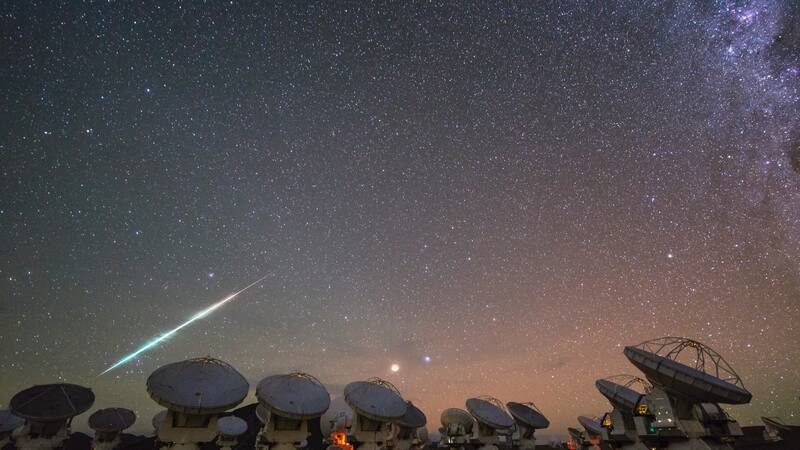
This beautiful new image, taken during a time-lapse set at the Atacama Large Millimeter/submillimeter Array (ALMA) is another dramatic Ultra High Definition photograph from the ESO Ultra HD Expedition. ALMA, located at 5000 metres above sea level on the remote and empty Chajnantor Plateau in the Chilean Andes, marks the second destination for the four ESO Photo Ambassadors [1] on their 17-day trip. The ambassadors are equipped with state-of-the-art Ultra HD tools to help them capture the true majesty of sights like the one pictured here [2] [3]. Some of the 66 high-precision antennas that comprise ALMA are visible here, with dishes pointed aloft, studying the cold clouds in interstellar space, and peering deep into the past at our mysterious cosmic origins. The spectacular javelin of light over the ALMA array is a shooting star, slicing through the image in a vivid streak of colours. Emerald green, golden and faint crimson hues blaze brightly as the meteor burns up as it enters the Earth’s atmosphere and makes its fiery voyage across the sky. As the high-speed fireball — which is, in reality, a small grain of rock from interplanetary space — interacts with the atmosphere it heats up, vapourising the surface layers of the meteor, which are left behind in a glowing trail. These trails disappear in just a few seconds, but are captured here at the click of a button. The brightest star in the constellation of Virgo (The Virgin), known as Spica, and our neighbouring planet Mars glow brightly in the centre of the image — cosmic spectators to this fiery descent as they rise above the horizon. The Ultra HD Expedition began in Santiago, Chile, on 25 March 2014. This image was taken on the team’s eighth night on the Chajnantor Plateau. They are currently at La Silla Observatory, ESO’s first astronomical installation in Chile, and tomorrow, after one last night, they will finally make the long journey home. Free Ultra HD content gained from this expedition will soon ESO/C. Malin
El debate generado por la decisión del Ministerio de Ciencia de exigir residencia definitiva para postular al concurso Fondecyt de Postdoctorado 2026 nos obliga a reflexionar sobre el sentido de la inversión pública en ciencia.
El valor de la investigación no se mide por la nacionalidad de quien la ejecuta, sino por el conocimiento y el desarrollo que transfiere al país. El caso de la astronomía es el más evidente. Chile posee la mayor concentración de observatorios del planeta, un privilegio geográfico que atrae de forma natural a las mentes más brillantes del mundo. Lejos de desplazar al talento local, la llegada de estos investigadores es el motor que hace crecer a los científicos chilenos en formación, experiencia y redes globales. Nuestra rápida y exitosa inserción con un rol protagónico en laboratorios de frontera como el CERN es prueba directa de que el aislamiento no es una opción viable.
Si el objetivo es generar valor local, la estrategia correcta es abrir nuevos fondos específicos para financiar la formación de personal técnico e ingenieril chileno. Existe una oportunidad histórica desaprovechada en el área de mantenimiento y desarrollo de instrumentación astronómica nacional. Enfocar recursos en capacitar a nuestros técnicos e ingenieros creará un valor público de largo plazo, sin necesidad de desmantelar los puentes científicos internacionales que tanto ha costado construir.